Details to follow, but this will be at the Museum of Somerset from 1030-1230.
Mick Astons Young Archaeologists (Somerset)
Details to follow, but this will be at the Museum of Somerset from 1030-1230.
Saturday 6th January in the Learning Room at the
Museum of Somerset from 10.30am – 12.30pm.
As we all know archaeology is the study of the past and in several of
our 2023 sessions we looked at the different ways archaeologists record
what they find. In a fitting start to the New Year we will be looking
at the new ways we can use technology to digitally record and spread the
news of the latest archaeological discoveries as they happen!
Caroline Pathy-Barker will be showing us how to make an Archaeological
Blog! We will be thinking about the sort of questions we might need to
include and recording mini-interviews and uploading them.
Please could you bring a mobile phones if you have one. To make the
blog it would help if we can download an app so if necessary please
could you get permission to do this from your parents/carers. It would
save time if you could download the app beforehand so we will send out
the link asap. If you don’t have your own phone we can work in teams
with a MAYA Volunteer.
This will be an exciting session as it will also include the visit from
Rebecca from YAC HQ who will be talking to us about what we enjoy about
being a member of MAYA!
Please email to book your place on this fascinating session! When you
email please could you let me know if you have your own phone and send
confirmation from your parents/carers if you can download the app.
Our next session will be our Christmas Party on Saturday 2nd December! It will be held in the Learning Room in the Museum of Somerset in Taunton from 10.30am – 12.30pm.
In the session we will be looking at what the mid-winter solstice meant to people in the past based on the megalithic monuments the built. We will also be making our own solstice Christmas candles to take home! We will finish off with party food and games!
Please email to book your place for this fun and seasonal session!
For our September session we were back in the Museum of Somerset after our visits and fieldwork over the summer. The session was planned and run for us by Chris Webster and Chris Jessop and was all about how archaeologists record everything while they are excavating.
At the start of the session Chris W gave a short PowerPoint talk about why it was so important that archaeologists recorded everything while they are digging, including plans, photographs and context sheets. This is because when you dig up archaeology you are in effect destroying it!
The MAYANS then split up into four groups around four specially prepared indoor test pits. These were layers of 1m square cardboard sheets representing different contexts. In between the sheets were artefacts for the MAYANS to find and plan using a 1m x 1m planning frame like the ones used on real excavations. For each layer they had to fill in a context sheet describing everything they saw.
During the session the MAYANS also had chance to look at different types of surveying equipment used to record the height or “level” of their test pits. This type of equipment had changed a lot over the decades and we were able to show them an old fashioned dumpy level and staff where everything looks upside down and back to front, right up to a modern day GPS which connects to satellites to show very precise location and height.
At the end of the session each group told everyone the story of their test pit, describing what they thought had occurred there in the past using the evidence they had found… good fun as well as being a great learning experience! A big thank you to Chris W and Chris J for all their preparation and for running such a great session for us!


Our next session will be on Saturday 4th November 10.30am – 12.30pm in
the Learning Room at the Museum of Somerset.
The topic will be Prehistoric Henges! What are these mysterious ancient
earthworks? The most famous is Stonehenge but there are many more
scattered across the UK and Ireland. Who built them and how? What were
they used for? They are not found anywhere else in the world so come
along to our next session to unravel the mystery of these huge circular
monuments!
Please email to book your place for this session.
The session will run from 1030-1230 at the Learning Rooms at the Museum of Somerset.
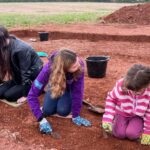
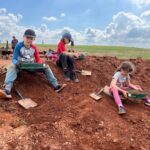
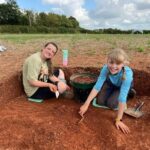
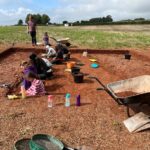
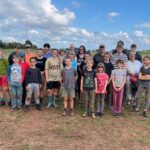
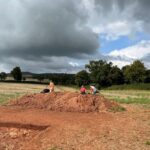
For our September session MAYA members were invited by Richard, Cheryl and Tara from Context One Heritage and Archaeology to take part in their excavations at Broomfield on the Quantock Hills. They were trying to find out the nature and date of a large, circular ditch almost 100m across, identified on aerial photos and geophysical surveying. This was a great opportunity for our members as we don’t often ge
t a chance to do some actual digging, especially as our August test pitting was cancelled due to bad weather.
We were given a tour of the site and then
we split up into groups to do some digging. There were three trenches, one on the big ditch and two on other anomalies located by the geophysical survey. The MAYANS carefully scraped back the soil looking for artefacts and any changes in the colour of the soil which could be postholes. Those working in the big ditch were also trying to define the edges of the ditch.
This was quite near the start of the dig and no artefacts were found apart from two very tiny pieces of pottery. The fact that there were so little finds, plus the size of the ditch suggests the circular enclosure could be Neolithic or Bronze Age. The archaeologist who were running the dig were very impressed by how careful and dedicated the MAYANS were whilst they were working.
This was a really great day for our members and we would like to thank Richard McConnell, Cheryl Green and Tara Fairclough for giving MAYA this exciting opportunity, plus Dan Broadbent from the Quantock Hills Landscape Partnership for organising transport to enable us to get to the site.
Our next session will be on Saturday 2nd September where we have been invited by Context One Archaeology to take part in their excavation of a prehistoric site near Broomfield on the Quantock Hills!
The site was discovered by aerial photography where changes in the growth of crops planted in the field reveal a circular enclosure nearly 100m across. The size and shape of the enclosure suggest it could be Neolithic or Bronze Age. The purpose of the excavation is to find out exactly what and how old the enclosure is.
There is hardly any parking at the site and so the Quantock Hills Landscape Partnership have arranged for minibuses to take us up there. The minibuses will pick us up at 10am from Castle Green outside the Museum of Somerset. I will confirm the time we’ll get back to Taunton nearer the time but this will probably be around 3.30 -4pm.
Please bring:
Warm and waterproof clothing and footwear
Sunhat and sun cream
Lunch, drinks and snacks
Gardening kneeler and gloves if you have them.
Please email to book your place on this exciting opportunity!
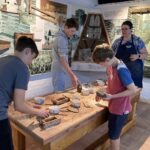
For our July session we returned to the Somerset Brick and Tile Museum in Bridgwater. We were last there five years ago so nearly all our members had not been there before. The session was run for us by Marie from the South West Heritage Trust.
After an introductory talk, Marie took us on a short walk to look at different types of brickwork in some of the houses near the museum. We also saw the remains of the Bridgwater glass kiln which must had looked amazing when it used to tower over the surrounding buildings.
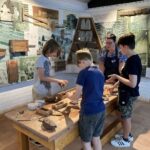
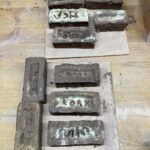
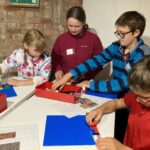
When we got back to the museum we split up into three different groups for different activities. One group made miniature bricks with Marie using old fashioned wooden brick moulds. We carved our names or patterns onto our bricks so we’d know which was which. These will be dried and fired by Marie and then returned to us at a later date.
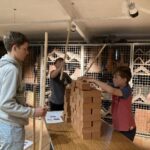
The second group replicated the different types of brick bonds that we had seen in the buildings on our walk outside – using Lego! Great fun! The third group built structures out of large foam bricks and then shook the table they were on to see how they would withstand an earthquake. We threaded broom handles down through the holes in the brick walls to reinforce them.
This was a fun session with a great variety of activities and by the end of it we knew a great deal more about the humble brick! A big thank you to Marie for running this session for us.
The first of our Summer digs will be on Saturday 5th August at the village of East Lambrook near South Petherton. We will meet at East Lambrook Manor Gardens at 9.30am (postcode TA13 5HH). Meet at 3.30pm in the car park for pick up. Please bring:
We will be digging a number of test pits near the village centre to try and find out information about the date of the origin of the village. Some of the buildings date back to 15th and 16th centuries, or possibly earlier.
We have been invited to East Lambrook by the Kingsbury Time Travellers and MAYA’s visit will be the launch of a major new archaeological project in the village.
Please email to book your place for this exciting opportunity!
© 2026 MAYA
Theme by Anders Noren — Up ↑
Recent Comments