Mick Astons Young Archaeologists (Somerset)

Category: News (Page 1 of 6)

3rd October – Processing Archaeological Finds

This month we were back at the Museum of Somerset in Taunton.  The session was led for us by Anne Teather and Andrew Chamberlain who had organised the test pitting day for us in their garden last month.

Anne started out with a PowerPoint talk about what happens when the excavation is over, including washing the finds, sorting and weighing them, identification by experts and finally a written report pulling everything together.

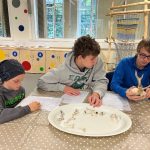
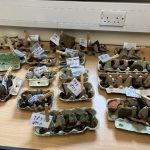
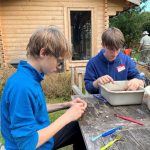
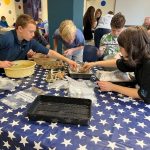
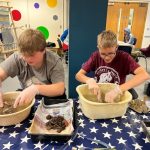
After this the MAYANS began to wash and sort the finds they had recovered from the test pitting in September, including brick and tiles, pottery, glass, clinker, animal bones and rusty iron artefacts.  Some of the more unusual items included the metal clasp of a purse and a glass marble.

Anne and Andrew had also brought along some other artefacts, including animal and human bones and a collection of clay pipes.  The MAYANS took it in turns having a break from finds washing to take a look at these other artefacts.  Anne and Andrew had prepared a number of activities including working out what the animals ate from the sort of teeth they had, identifying different types of bones, and working out the styles and dates of the clay pipes.

A big thank you to Anne and Andrew for coming over to Taunton and for organising another really interesting session for us!
 

12th September – Test Pitting at Marston Magna

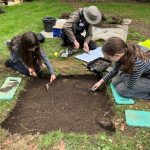
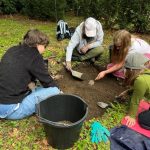
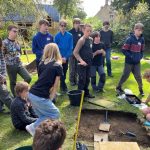
This September we were invited to Marston Magna for a test pitting day organised by Anne Teather and Andrew Chamberlain of Past Participate, a community archaeological research organisation.  We were digging in the grounds of the Old Rectory House to see if we could find any artefacts connected with the former buildings and what sort of activities could have taken place there.

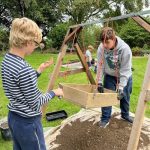
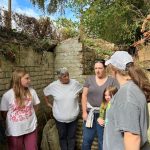
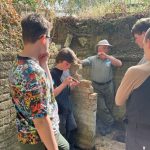
Five test pits were dug, all of which uncovered a variety of finds including building rubble, pottery, glass, clinker, animal bones and rusty iron artefacts.  After lunch we had a break from digging while Andrew showed the MAYANS around a WWII brick-built air raid shelter that he had excavated which was a fascinating opportunity for our members.

All the test pits were meticulously recorded by the MAYANS using paperwork designed by Carenza Lewis from the “Time Team”.  The finds will be washed and sorted at our next sessions, and a report will be written and submitted to the Historic Environment Record.

It was a day of great enthusiasm and discovery and we would like to give a big thank you to Anne and Andrew for their hospitality and for giving our members such a fantastic experience!

4th July – Brean Down

A few pictures from our recent trip to Brean Down with the National Trust!


9th May – MAYA Visit to Fyne Court

For our May session we visited Fyne Court on the Quantock Hills which was once the site of a Georgian mansion and landscaped gardens.  The house was destroyed by fire in the 19th century and the traditional garden has been largely lost.  Our job was to read the clues left behind in the landscape to try and find out what the site had been like in the past.

We had been invited along by Cat Lodge and Jess Midgley from the National Trust who now own the site.  We started out by looking at lots of maps of the area, including tithe maps and old Ordnance Survey maps right up to modern day LiDAR.  We compared the maps to see what had changed over the years.

After this we ventured out into the grounds and surrounding fields to look for clues about what the gardens and landscape had looked like in the past.  We quickly realised that the house had been under the lawn just outside, now full of deckchairs and picnickers!

As we explored further afield we found a ha-ha which was constructed to stop cattle getting into the formal gardens.  We also found stone pillars which had once supported a bridge along a footpath where the occupants of the mansion had walked to church.  We ended up in a beautiful buttercup filled field where we spotted a rectangular bank forming some sort of enclosure, which was probably part of a Deserted Medieval Village.

After this we walked to the site of the old walled garden where fruit and vegetables to feed the owners of the mansion would have been grown.

It was a lovely sunny day, perfect for a bit of landscape detective work. A big thank you to Cat and Jess for inviting us and for such an interesting day!

25th April – MAYA 10th Anniversary!

It’s hard to believe that it’s been 10 years since we first launched MAYA back in April 2016! We wanted to go somewhere really special to celebrate, so where better than Avalon Archaeology Park where we have had so many amazing sessions over the years.

The session was run for us by Marc Cox who manages the Park. He had prepared two great activities for us – painting the Iron Age round house using authentic methods, and woodworking with Neolithic and Bronze Age axes.

We started out making the paint for the round house by mixing different colours of ground ochre with egg yolk and milk curds. We then made our own paint brushes from willow and horse hair. Mark had sketched out a design on the outside of the round house for us to decorate. Half the group did this while the others had a tour around the rest of the Archaeology Park, looking at the amazing Roman dining room and Saxon Long Hall. We then swapped over so everyone could take part in all activities.

After this we stopped to celebrate our 10th anniversary with a special celebration cake! A big thank you to Pam for making this for us.

For the last activity Marc handed round a variety of flint, copper and bronze axes. We then took it in turns to use the copper axe to chop a silver birch tree trunk in half. Marc explained that this method would have been used to construct the prehistoric wooden trackways found across the Somerset Levels.

A big thank you to Marc for organising such a fantastic session for our special celebration and to everyone else who has supported MAYA over the past ten years!


7th March – The Cheddar Brooch

We were back in the Museum of Somerset this month for a session which was all about a very special object in the museum’s collection – the Cheddar Brooch.  This unique item is over a thousand years old and is one of the most important objects every discovered in Somerset.

The session was led for us by Dan Broadbent who talked about the history of the brooch and how it was found by a metal detectorist.  It is decorated with intertwining animals and plants, including different types of dragons.  After conservation the brooch has been put on display in the museum.

After Dan’s talk we split up into groups.  One group went to visit the brooch in the museum and the others made replicas of the brooch out of gold and silver card.  We were also lucky enough to be visited by Nessie, a re-enactor who brought along Saxon artefacts, weapons, clothing and other objects for us to look at.  The groups rotated so we could all get chance to do all the activities.

At the end of the session Dan told us some Saxon tales and legends which included dragons like the ones on the brooch.

A big thank you to Dan and Nessie for coming along to give us such a fascinating session!

7th February – Second World War sites in Donyatt

This month we were treated to a really special session. We were taken on a guided walk around WWII archaeological sites in Donyatt which formed part of the anti-tank defences of the Taunton Stop Line.  Our guide was Chris Webster from the South West Heritage Trust.

Despite the pouring rain, our MAYANS were undaunted and we had a good turn-out.  Chris showed us a number of fascinating and sometimes partially hidden sites, including pill boxes, gun emplacements and huge concrete anti-tank blocks.  The tour also included a walk along the former Ilminster – Chard railway line near Donyatt Halt which was lined by anti-tank concrete blocks and posts.

The pill boxes we visited were on private land and we are very grateful to the landowners for giving us access to these extraordinary historical sites.

A massive thank you to Chris for coming out in the pouring rain to run this fascinating and memorable session!

3rd January – Prehistoric Cave Art

In our first session of 2026 we learnt about Upper Palaeolithic Cave Art in Europe.  We started out with a PowerPoint presentation about where cave art was found, what kinds of things were painted, and discussed why people might have painted them.  We also looked at how the paints were made out of minerals and organic materials and how we could use this to date the art.  We finished with a quick look at prehistoric cave art from other parts of the world.

After a short break we then designed and painted some cave art of our own!  Each of our MAYANS were given a flat pebble to paint.  We had lots of pictures of cave art from all sorts of different site to inspire them.  The designs they came up with were fantastic, very varied and colourful.  The pebbles were dry by the end of the session so they could take them home with them.

We also had a virtual walk through tour around the cave at Lascaux in France which is one of the most famous cave art sites in the world.  Throughout the session the MAYANS took it in turns exploring this amazing site on the computer.

Finally our MAYANS also decorated a long freeze with cave art, a combined effort which produced an amazingly colourful result!  The most popular image was definitely the hand print which is a common motive in prehistoric cave art, and we ended up with some amazingly colourful hands as well!  A really messy but really fun session!

6th December – MAYA Christmas Party!

We had a special guest for our Christmas Party this year, storyteller Dan Broadbent.  Dan told us an amazing selection of local tales, legends and ghost stories.  Dan explained how important these stories were as they had been passed down through generations of local people and could reflect ancient beliefs and practices.  Dan also explained that telling ghost stories at Christmas was an old Victorian tradition.

We dimmed the lights and lit the room with about a hundred LED candles so it was very atmospheric – especially when Dan told us about the ghosts who were supposed to haunt Taunton Castle where we meet!

After Dan had finished, we had our Christmas party with loads of food, crackers and pass the parcel and a lucky dip.

It has been a really great year for MAYA and we have a lot of activities planned for 2026, which will be our tenth anniversary!  A huge thank you to Dan and to everyone who has supported us over the past year and helped to make MAYA such a success!


1st November – Brean Down and Virtual Reality

For our November session we were back in the Museum of Somerset after being out and about all summer.  Unfortunately we had to cancel our October session at Fyne Court due to Storm Amy but we hope to reschedule that session for next year.

This month we were visited by Ian and Jas from the National Trust.  Ian showed us a PowerPoint about the amazing archaeology on the Bread Down headland near Weston super Mare.  He also brought some activity sheets where we had to work out where the people who lived on Brean Down in the Iron Age fished and farmed and built their fort and village.

Jas had brought along two Virtual Reality headsets and while we were doing the activity sheets we took it in turns to have a go using them which was amazing!

After a short break we passed around a number of replica artefacts from different time periods and the MAYANS had to work out what they were, when they dated from and whether the people living on Brean Down would have used them.  The objects included a Neolithic hand axe, replica Bronze Age axes, an Iron Age torc bracelet, Roman pottery and a Saxon helmet.  Ian told us there was evidence that people lived on Brean Down in all these time periods apart from the Saxons.

The National Trust have very kindly offered to take us on a guided walk at Brean Down next Summer so we can see for ourselves the fascinating archaeology and history of the headland.  A big thank you to Ian and Jas for organising such a great session!

« Older posts

© 2026 MAYA

Theme by Anders Noren — Up ↑