Mick Astons Young Archaeologists (Somerset)

Author: Admin (Page 7 of 16)

MAYA visit to Caerleon Roman Fort – 13th May 2023

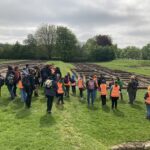
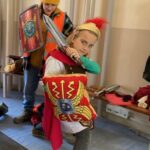
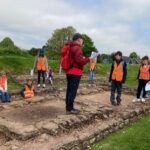
For our May session we went on a coach trip to Caerleon Roman Fort in South Wales.  Upon arriving at the fort we started out by looking at the remains of the Roman barracks.  These were very well preserved and it was great to see the layout of the buildings so clearly and work out how many soldiers lived in each one.  It must have been quite crowded!  We also saw the remains of the communal toilet which caused the MAYANS much amusement!

After this we split into two groups, one to look around the general museum for the fort and the other to visit the Roman baths which has its own separate museum.  The remains of the baths were amazing and we could walk on platforms above the actual walls and see all the different types of buildings.  There were video projections of Roman people swimming in the large pool which was amazing!

The other museum had many of the artefacts discovered when the site was excavated, including pottery, glass, cremations vessels and beautiful intaglio stones which would have been set into rings.  We were all amazed at how tiny and detailed these were.

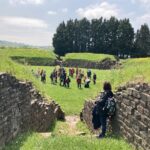
We ended the day in the huge Roman amphitheatre which was very impressive, before getting the coach back to Taunton.  A big thank you to MAYA volunteers Chris Webster and Dave Jones who organised the visit and guided us around this fascinating site!


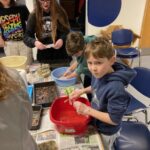
Visit to the Brick and Tile Museum – 1st July

Our next session will be on Saturday 1st July and will be at the
Bridgewater Brick and Tile Museum.  During the session we will be making
copies of an archaeological artefact out of clay.  These will then be
fired and returned to you at the following session.  The cost for the
session will be £5 per person to pay for materials and firing.

The session will run from 10.30am – 12.30pm.  Parking at the Brick and
Tile Museum is extremely limited so please park in the Bridgwater Retail
Park TA6 4AB around the corner from the museum.

Due to limited work spaces at the Museum, the staff have asked if we can
limit the number to 18 members for this session.  Places will be on a
first come first served basis.  If we are over-subscribed we will
arrange a return visit next year.

Finally although aprons are supplied, please wear clothing you don’t
mind getting a bit muddy!

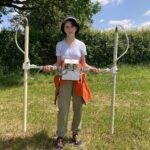
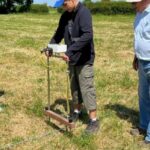
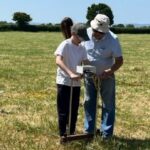
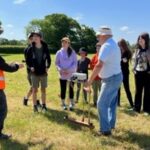
Geophysics session – 3rd June

We will be carrying out a
resistivity survey over the site of a Roman barn which was partly
excavated in the past to check its state of preservation.

The session will run from 10.30am to 2.30pm.  We will meet in the farm
yard at Stapleton Mead Farm, Stapleton near Martock.  The post code for
the site is TA12 6AP.

Please bring:
A packed lunch
Drinks and snacks
Sturdy footwear
Sun hat and sun cream – the weather forecast is for sunshine and the sun
can be very strong this time of year
Rain coat – just in case!  Also the site is quite exposed and the wind
can be quite strong and cold

Depending on the amount of interest we may have to limit numbers for
this session so please let me know as soon as possible if you would like
to attend.

Mosaics and Viking Carvings! – 1st April 2023

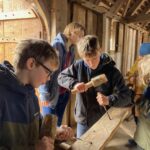
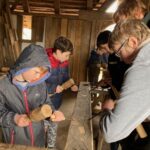
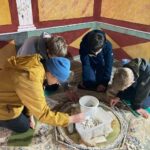
For our March session the MAYANS returned to the Avalon Archaeology Park near Shapwick.  The session was run for us by Dr Richard Brunning from the South West Heritage Trust, and for this visit Richard had organised mosaic laying and Viking wood carving!  After an introductory talk we split into two groups, one to work in the Roman building and the other in the Saxon long hall.

The group in the Roman building were going to lay tesserae for part of the beautiful mosaic floor that Richard and the other volunteers at the Archaeology Park have been working on for over a year, and it was a real treat to be part of this special project.  The MAYANS were supervised by Richard’s friend Martin who had prepared two areas for us to work on.  It was great to think that in years to come the MAYANS could return to the building and show their friends and family what they had done.

The second group worked in the Saxon long hall where Richard showed them how to make the beautiful wood carvings that decorate the hall using chisels and wooden mallets.  This was tricky work as the designs were quite complicated but the MAYANS soon got the hang of it.  It really made you realise how much work has gone into the reconstruction of these buildings!

After a break the groups swapped over so everyone could have a go at both activities.  The Archaeology Park is such a wonderful place for our members to visit with its amazing reconstructed buildings and exciting activities.  A big thank you to Richard and Martin for inviting us back and for all their help and support for MAYA!

Medieval and Post-Medieval Pottery – 4th February 2023

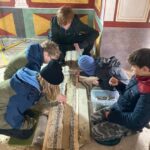
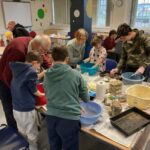
For our February session we returned to post-excavation work on the artefacts we discovered during test pitting at Longaller Mill.  We were fortunate enough to have David Dawson join us who is one of the country’s leading experts on pottery, especially Medieval and Post-Medieval pottery which is what we expected to find in the test pits.

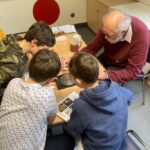
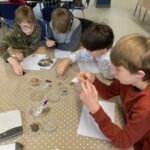
David began the session with a PowerPoint presentation, getting the MAYANS to think about the fabric, form, finish and function of pottery.  After this we divided up into several group to continue the post excavation work.  This included finishing off the finds washing we had started in the November session, plus sorting, weighing and recording the finds which had already been washed and dried.  The MAYANS took the pottery sherds they found over to David for identification and recording.

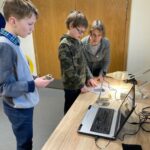
We also had access to a Dino-lite magnification scanner which, when connected to a laptop, revealed amazingly detailed, magnified pictures of the pottery plus other finds such as flint and bone.

This was a great opportunity for the MAYANS to learn about the all the types of pottery sherds they had found, and appreciate how these can be used to help date when the old buildings had been occupied.  A big thank you to David for coming along and for all his help with this fascinating session!


1st April – Mosaics and Viking wood carving

Out next MAYA session will be at the Avalon Archaeology Park at Shapwick
near Glastonbury.  Many of you will have been here before and know what
a fantastic place this is for us to visit!  The postcode for the site is
BA6 9TT.

The session will run from 10.30am – around 1pm.  Please bring a drink
and snack.  If you would like to stay on for lunch there is a cafe on
site or you could bring a packed lunch, but there will be no organised
activities in the afternoon.

In this session we will be laying mosaic tiles in the Roman building,
plus doing Viking wood carvings.  Please wear warm clothing that you
don’t mind getting dirty!

At the request of the organisers, we will have to limit our numbers to
20 members for this session as there is limited space in the Roman
building.  Places will be booked on a first come, first served basis.
If you don’t manage to get a place you will be given priority for the
next session we hold at the Archaeology Park.

IT IS VERY IMPORTANT THAT YOU EMAIL TO BOOK YOUR PLACE!

4th February – Finds processing

During this session, we will continue the finds processing from our excavation at Longaller Mill, including how to sort and date medieval and post-medieval pottery. The session will run from 1030-1230 at the Learning Rooms at the Museum of Somerset.


Indoor dig at the Museum of Somerset – 7th January 2023

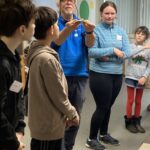
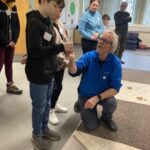
For our first MAYA session of 2023 we carried out an archaeological excavation… indoors!  The session was run for us by Dr Julian Richards who has been kind enough to run a number of MAYA sessions for us over the years.  This time we were to uncover the remains of a medieval abbey!

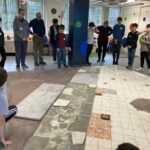
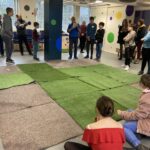
Julian prepared the session by putting down layers of carpet tiles, concealing artefacts between each layer.  He then started off by talking to the MAYANS about the sorts of materials we could find when we carried out an excavation – what would rot over time and what would not rot.  He demonstrated this by a variety of objects made from wood, plastic, glass, cardboard etc, even a rotten old banana skin!

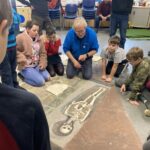
We then started to take up the individual carpet tiles to reveal what was underneath, looking at the finds and trying to work out the nature of the site.  Finally we uncovered the remains of a medieval abbey, including a grave stone which we lifted to discover the remains of a skeleton.  After a discussion about what we can learn from an examination of human bones, we realised that the skeleton was female and the abbey was probably a place for nuns not monks.

Julian then finished by showing us a short film about a community dig at Shaftesbury Abbey, which was the first abbey in the country founded for nuns in 888 by King Alfred, whose daughter was the first abbess.

This was a really exciting and interesting session and we would like to say a huge thank you to Julian and his wife Sue for running it for us!


« Older posts Newer posts »

© 2026 MAYA

Theme by Anders NorenUp ↑